
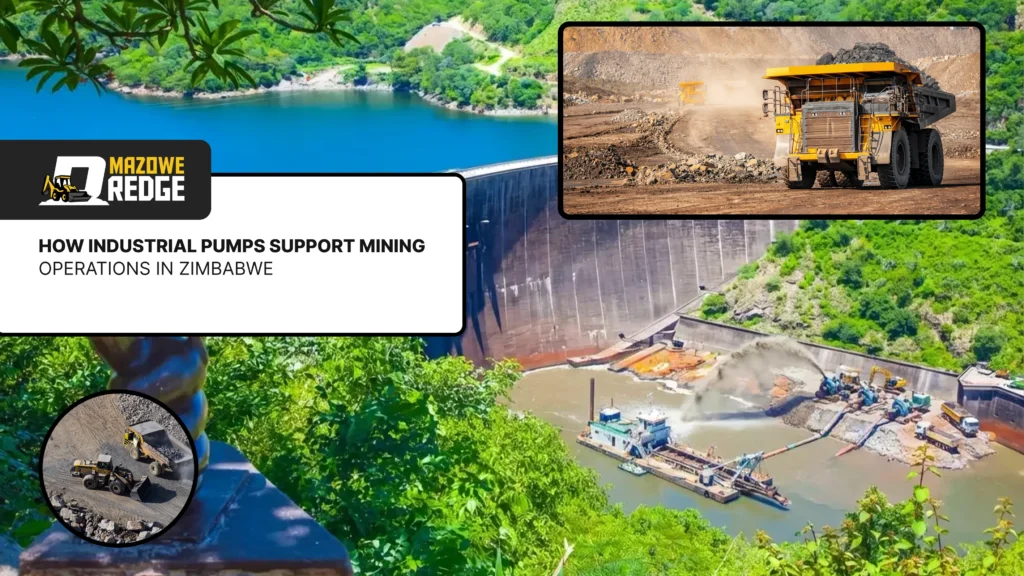
How Industrial Pumps Support Mining Operations in Zimbabwe
Mining sites in Zimbabwe deal with water and material movement on a daily basis. Open pits fill during the rainy season; tailings must be moved without blocking lines, and dredging depends on steady flow rather than peak performance metrics. In these conditions, industrial pumps are not supporting equipment. They determine whether work continues or stops. Most mining operations across Zimbabwe face similar issues. Slurry contains sharp solids, water tables change quickly, and sites are often far from immediate technical support. This is where pump selection becomes a practical decision, not a specification exercise. Pumps that look suitable on paper often fail early when exposed to abrasive material or continuous duty cycles, especially in Zimbabwe dredging projects. Mazowe Dredge works with mining operators who need pumping systems that match site conditions rather than generic catalog ratings. The company supplies industrial pumps for dewatering, slurry transfer, and dredging, along with pipes, hoses, and system components commonly used on local projects. Importantly, the equipment is supported locally, reducing downtime when operating conditions change. This article examines how industrial pumps are used across mining operations in Zimbabwe, where failures are common, and what to consider when selecting pumps for dredging and slurry-handling work. The focus is on practical operation, not theory, and on solutions that align with real project conditions in Zimbabwe. Zimbabwe Mining Conditions and Why Pump Selection is Not Straightforward Mining sites in Zimbabwe rarely operate under controlled conditions. Water levels change quickly, material quality varies from one section of a site to another, and pumping equipment is often expected to run for long hours without interruption. As a result, industrial pumps used in mining operations are often operated beyond standard specifications. In many gold and alluvial mining areas, slurry contains a high percentage of sand and sharp particles. This causes faster wear on impellers and internal liners, especially when pumps are selected based only on flow rate. In Zimbabwe dredging projects this becomes more noticeable. Sediment composition can change within the same river stretch, which means a pump that performs well in one area may struggle a few days later. Another common issue is access. Several mining operations are located far from service centres. When a pump fails, replacement parts are not always available immediately. This makes reliability and simplicity more important than peak efficiency. Pumps that are easy to inspect, maintain, and repair on site tend to perform better over time, even if their output is lower on paper. Power supply also affects pump performance. Some sites operate on generators, while others deal with unstable grid power. Pumps that are sensitive to voltage fluctuations often experience seal or motor issues. In these cases, choosing robust industrial pumps with lower operating speeds and proven field performance becomes a practical necessity rather than a technical preference. Mazowe Dredge works around these realities by supplying pumping equipment that is already used in similar mining and dredging environments. Instead of matching pumps solely to calculations, selection is based on how the equipment behaves with abrasive materials, long-run hours, and limited maintenance windows. This approach aligns more closely with how mining operations operate in Zimbabwe. How Pumps are Used on Mining Sites in Zimbabwe On most mining sites, pumps operate continuously. Not as a system. Just to keep things moving. Water builds up, slurry needs to be shifted, and sediment has to be cleared. If the pump stops, work slows or stops completely. Dewatering is usually the first problem. Pits fill faster than expected, especially after rain. Water is rarely clean. It carries sand and fine solids. The pumps used here are expected to start every day and remain operational. Many sites move them often as the pit changes shape, so portability matters more than high output numbers. Slurry movement creates different issues. Tailings are heavy and abrasive. Particle size is not consistent. Lines block. Wear happens fast. In many mining operations, pumps are deliberately run slower to avoid frequent breakdowns. Losing some flow is better than changing parts every few weeks. Dredging work adds another layer. In Zimbabwe dredging projects, pumps deal with mixed material pulled directly from riverbeds. Some days it is fine sediment. Other days it includes stones. Discharge distances change as work progresses. That puts pressure not only on the pump, but also on hoses, joints, and fittings. Mazowe Dredge supplies industrial pumps used in these situations, along with the pipe and hose systems that connect them. The focus is not on a single task, but on keeping equipment working as site conditions change. That is how pumps are actually used on mining projects in Zimbabwe. Where Pumps Usually Fail First on Zimbabwe Mining Sites When a pump fails on a mining site, it is rarely sudden. Most failures accumulate over time, and the same components tend to fail first. In Zimbabwe, this pattern is consistent across mining operations and Zimbabwe dredging projects. Wear parts fail before motors. Impellers and liners take the hit from sand, grit, and sharp particles. On slurry and dredging work, this wear is uneven. One side of the impeller may thin faster, causing vibration long before anyone notices a drop in flow. By the time output falls, damage is already done. Seals are the next weak point. Dirty water and fine solids work their way past sealing surfaces, especially when pumps are stopped and restarted frequently. In dewatering applications, pumps are often switched on and off based on water levels. This cycling shortens seal life more than continuous operation. Bearings fail later, but when they do, the downtime is longer. Poor lubrication, misalignment, and vibration from worn impellers all contribute. At remote sites, bearing failures are more problematic because replacements are not always available locally and installation takes time. Power issues also play a role. Voltage drops and generator fluctuations affect motors and seals. Pumps may continue running, but heat builds up. Over time, this leads to insulation damage or seal hardening. These failures are common with industrial pumps that are not selected for unstable
How Industrial Pumps Support Mining Operations in Zimbabwe Read More »